
The story behind the collapse of the model that tokenized attention, content, and social engagement on X is worth studying before you commit budget to the “attention economy.”
The InfoFi model converted social attention into financial rewards by paying users with tokens for posting, replying, retweeting, and liking.
On X specifically, this spawned a whole category of “Post-to-Earn” apps that tracked engagement and distributed tokens accordingly.
It grew fast, attracted real capital, and for a while looked like a genuine Web3 social use case.
Then January 2026 happened.
What the InfoFi API Ban on X Revealed
X’s product head, Nikita Bier, announced the platform would no longer allow apps that financially incentivize users to post, and would revoke API access from affected developers.
The stated reason was spam control and X said the incentive model was motivating automated replies, low-quality engagement, and AI-generated noise across timelines.
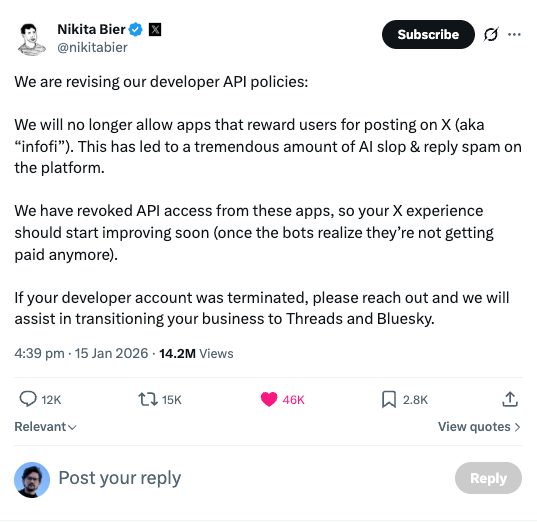
https://x.com/nikitabier/status/2011825522817270230
The InfoFi API ban on X 2025 wasn’t a surprise to anyone paying attention because reward-for-engagement mechanics have always attracted the worst people. Projects thought they were paying for growth, but they ended up paying for volume, and volume without quality is exactly what social platforms spend millions trying to suppress.
The move effectively halted impression farming, with projects forced to rethink their entire strategies overnight. The market reacted as expected.
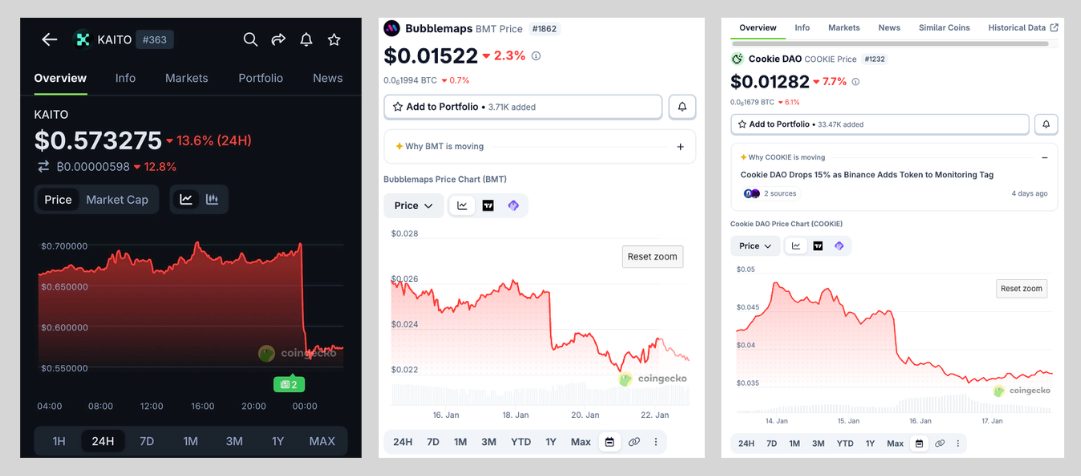
Sector data showed the InfoFi category’s market cap dropping. Sadly, that pretty much tells you how much of the value was dependent on X’s API.
The Structural Post-to-Earn Model Failure
The Post-to-Earn model ceiling was always there, I think. It wasn’t bad luck, or a coincidence with X’s API / Algo change.
Because when your core mechanic requires a third-party API to function, you’re building on rented land. This applies to followers, IP, data, anything. And such tenants tend to expire sooner or later, especially when the landlord decides tenants are making the house look bad.

The broader lesson from the InfoFi on X collapse is that the model worked only while the X APIs stayed open.
Sadly, platform dependency in crypto projects isn’t new or exclusive to CT.
We’ve seen it with app stores, with payment processors, with social platforms banning crypto ads in 2018, with platforms suddenly banning accounts with millions of followers, etc.
So, build on someone else’s infra, and be dependent on their agenda.
And for Web3 founders evaluating InfoFi tools right now, the thing you need to pay attention to is survival.
So,
Before You Allocate Growth Budget
What would happen to your product if X, or any platform you depend on, changes one policy tomorrow?
If you’re building in Web3 social or considering attention-based token models, get a clear view of what you own before you spend money on growth.
Lock in.